
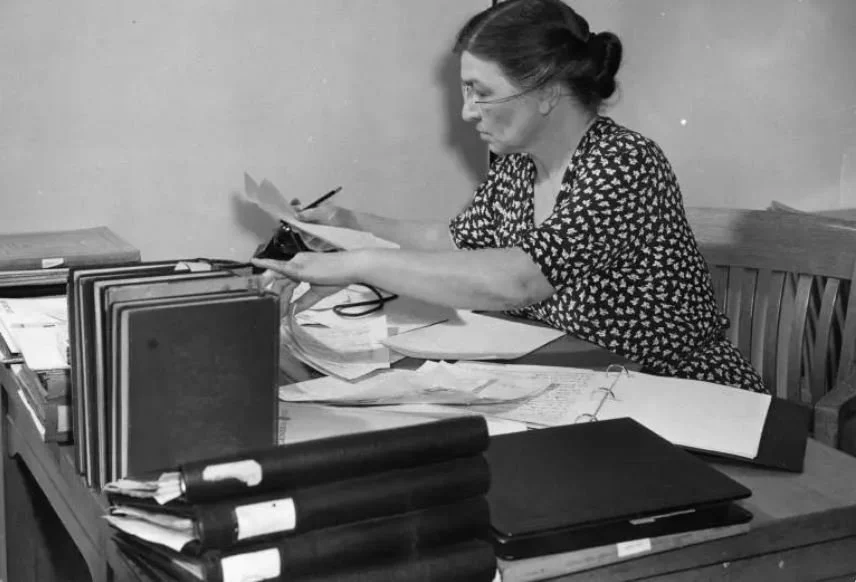
The electrical grid that we know today might not be possible without Edith Clarke. The first female electrical engineering professor in the US, she invented the Clarke calculator, a graphing calculator that enabled engineers to solve equations involving electric current, voltage, and impedance 10 times faster than by hand. Her electrical expertise also contributed to the design and building of hydroelectric dams, including the Hoover Dam, and paved the way for modern grids.
Typical of many women early in the STEM field, Clarke’s story is one of stifled opportunity and ultimately, perseverance. Despite graduating with high honors from Vassar College in 1908 and becoming the first woman to earn a master’s in electrical engineering from the Massachusetts Institute of Technology, Clarke had trouble finding an engineering job. She was hired as a computor, or someone who solves mathematical equations, at General Electric.
As researcher and historian Sandy Levins noted, “As a computor at GE, Clarke neither earned the same salary nor was afforded the same professional status as her male colleagues.” Frustrated, she left to travel and taught physics for a year in Turkey.
The powerhouse engineer behind our electrical infrastructure
When she returned to the US in 1922, Clarke was hired as an electrical engineer in GE’s Central Station Engineering department. This was a time when transmission lines were getting longer; longer lines meant greater electrical loads; and greater loads meant more chances for the system to go down. Mathematical models for assessing grid reliability at the time were better suited to smaller systems.
Clarke came up with a model for a power system and its behavioral characteristics that let engineers analyze these newly-emerging, more complex systems. In addition to the Clarke Calculator, her work was critical for the growth and development of the U.S. electric grid. In 1930, she became the head of the engineers at GE studying power stability.
Clarke also published 18 technical papers, and her textbook Circuit Analysis of AC Power Systems became the standard for the industry at the time. In the 1930s, she designed the turbine system for the Hoover Dam. The electricity it produced was stored in massive GE generators. Clarke’s pioneering system later was installed in similar power plants throughout the western United States.
A Legacy of “First”s
After a long career at GE, Clarke retired in 1945 and spent the next 10 years teaching electrical engineering at the University of Texas in Austin. She died in November 1959 in Baltimore and left behind quite the legacy:
First woman in the country to be employed as an electrical engineer
First woman to present a paper at the annual meeting of the American Institute of Electrical Engineers (AIEE)
First woman to become a fellow at AIEE, which later became the Institute of Electrical and Electronics Engineers (IEEE)
First female professor of electrical engineering in the United States
This Women’s History Month, we honor Edith Clarke not only as a barrier-breaking engineer, but as a foundational figure in the evolution of the reliable power systems we rely on every day.